Monday, May 30, 2011

Introduction to the History of Cognitive Neuroscience (Part 2)

Ok, so last post I described the first part of the history of methods in the cognitive neurosciences, when behavior goes wrong, then finding out what's wrong with the brain. For this section, I'll be discussing when we intentionally damage, or directly zap the brain. Before you get too creeped out, this has mostly (the mostly is important) been done on non-human animals. There are ethical issues with animal research, which have been noted and struggled with since the beginning of animal research. Marshall Hall, a pioneering researcher, laid out several principles in doing animal research (in 1831). These principles are pretty much in place now. How are they applied? For example, principle 4 ("Justifiable experiments should be carried out with the least possible infliction of suffering (often through the use of lower, less sentient animals") applied means that if we are studying individual neurons, we should study the simplest creature possible, whereas if we are studying, say, the visual system, we should study the "lowest" animal that is comparable to humans (in this case, the cat). All the while, we should make sure the animals are as comfortable as possible. 


So, where should we begin? The first psychologist was not a psychologist at all, but a German physiologist named Gustav Fechner. Whereas Descartes thought that the brain communicated with the body through a series of tubes (that's right, Ted Stevens), Fechner demonstrated that it was electricity. Not only that, but he showed that it took time for the brain (of a frog) to communicate with its leg. It was previously thought that brain-body communication was immediate. But now, it was a very very very short amount of time. But that instant could now be measured. And Fechner, and his fellow German physiologists went about measuring the relationship between the physics in the world (like light, or sound, or electric shock) and our psychological experience of the physics. Now that each could be measured, we had a psychophysics. Fechner was born in 1801, and so most of this work was in the early and middle 1800's.

Of course, there were skeptics about the use of zapping a frog in explaining the human mind. William James himself wrote (in 1907, in On Pragmatism): 
Many persons nowadays seem to think that any conclusion must be very scientific if the arguments in favor of it are derived from twitching of frogs' legs—especially if the frogs are decapitated—and that—on the other hand—any doctrine chiefly vouched for by the feelings of human beings—with heads on their shoulders—must be benighted and superstitious. 
But there were now neurons, and soon there would be neurons working together. Donald Hebb, and much later, Eric Kandel, began to discover the way, at the cellular level, that neurons communicate and remember. As the decades went by, different animals (from sea slugs, to cats, to, in very rare cases, monkeys) had different parts of their brains surgically changed, and their behavior was recorded. A map of the brain was beginning to emerge.

I'll mention a few more cases of changing the brain, then observing behavior. The first was an experimental  surgery to relieve extreme epilepsy. It was 1953, and 27-year-old Henry Moliason was referred to a reckless doctor named William Beecher Scoville. Henry's epilepsy was localized to a structure in his brain located in the middle of his temporal lobes, on the side, tucked underneath. Scoville removed an entire section of his brain around this area, and thereby improved Henry's epilepsy. After recovery, Henry could see, hear, walk, talk, breathe, eat and drink just fine. But he needed to be institutionalized for the rest of his life. Why? Because Scoville unwittingly removed Henry's ability to make new memories. Someone could go into Henry's room, meet him, leave, wait a minute, then reenter and meet Henry again. For Henry, it would be "for the first time". Later studies showed that Henry could learn new skills, but would never remember having practiced them, so the memory damaged seemed to be only his conscious, or explicit memory.

In the past decade a new technology has allowed us to selectively "damage" human brains, but only temporarily. Imagine applying a little shot of anesthesia and paralysis to a certain small group of neurons and seeing what happens. This is exactly (ok, not exactly, but close enough) what transcranial magnetic stimulation is able to do. Zap Broca's area with a targeted magnetic field, whammo, you can't talk. For a few minutes. Then you are fine.

While Henry Moliason (or Patient HM, as he was known for most of his life in the memory literature) was a uniquely tragic, yet informative patient, for over a hundred years, cognitive neuroscientists have been changing the brains of animals and observing and recording the ensuring behavior. This has given us tremendous insight into how the mind and brain are linked, from organization of the visual system, to different memory systems, to systems of how our brains control our muscles. With the progression of technology to TMS, we are now able to very selectively "damage" human brains, and observe the associated behavior. But this is built on an increasingly detailed map of the brain, which in turn was surveyed using thousands of human and animal studies.

Introduction to the History of Cognitive Neuroscience

Recently, spurred on by the Kanazawa business, Ta-Nehisi Coates asked about Evo psych in general in one of his special "Talk to Me Like I'm Stupid" sessions. This spurred on a lively discussion (mostly piling on about how terrible it is) but led down an interesting road, when a commenter named neocortex noted that evo psych makes its claims on the connection between evolution and the brain, based on our limited understanding of the link between brain and behavior. She urged everyone to consider that cognitive neuroscience is still very young as a field, and therefore evo psych is necessarily built on a shaky foundation. Several (besides me) other people disagreed with the metaphor of "foundations" for different levels of explanation (you can explain atoms, molecules, neurons, brains, behavior). But I have continued to think about this, because some of the misconceptions shared by neocortex and others (her comment was later elevated by Coates, and commended as excellent) get at a fundamental misconception of a lot of science, but psychology is often a victim of this "we don't know anything" attitude. I think what most disturbed me was a seemingly small error in words, which is a linchpin in my argument against her point of view.

Here is the quote:
Disciplines like functional neuroimaging (which shows us how different thoughts and actions activate different brain regions) have only been around for a couple of decades or less
Look at my beautiful brain!
What's wrong? Functional neuroimaging is not a discipline, but a tool. The discipline she is speaking of is cognitive neuroscience, but she acts as if the tool is the discipline. We don't say that biology is only as old as the electron microscope or that physics is only as old as the supercollider, but yet this statement passes for truth, even from someone who has extensive undergraduate experience in neuroscience. Interestingly, increasing knowledge in a certain field can sometimes lead new learners to conclude that there are so many questions left as to render the current state of knowledge tiny in comparison.
I think we can understand a lot about the nature of science by studying the history of science, and distinguishing questions from tools, so here is my contribution to correcting that misconception.

The field of cognitive neuroscience is actually quite old. What is the connection between our biology and our thoughts? How does our brain create our mind? This question has been around longer than any consensus that our brain does create our mind, to the very beginning of biology itself. And scientific reasoning (however basic) has been used from the start.

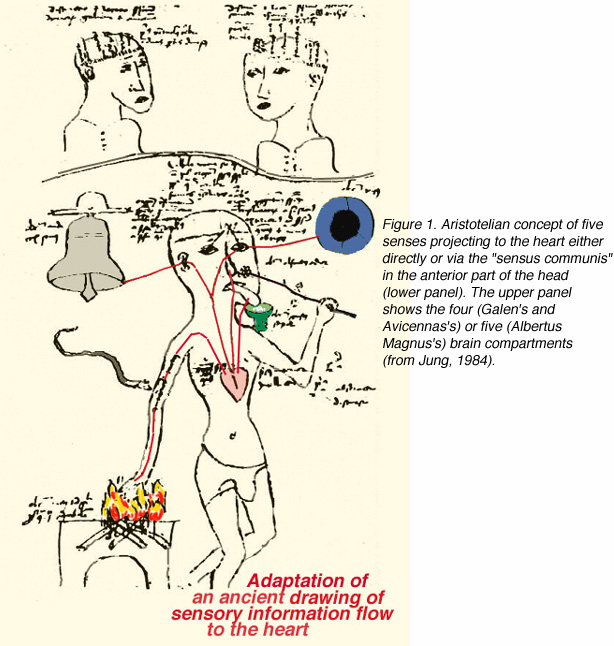
We start with Aristotle, who thought that the brain was responsible for cooling the blood, while the heart was the seat of reason. Why? One can survive a blow to the head, but not to the heart. The heart must be more important for conscious thought.
Of course, he was wrong, but his logic was impeccable, and forms one third of the logic of modern cognitive neuroscience.
There are three basic ways that cognitive neuroscience gains knowledge about the brain. This is not the only way of classifying the logic of cognitive neuroscience, but it nicely draws attention to the history of evidence in cognitive neuroscience.

1) We observe a change in behavior, due to known injury or biological disease . We classify this behavior. Then, we figure out where, and how, their brain injury (or disease) correlates to their behavior. In this case, the behavior is known first (think, memory problems in Alzheimers, or amnesia after an accident) then later the biological basis is described. I will discuss this part today, and continue with the others tomorrow.

2) A known part of the brain is either injured or stimulated (on purpose). In this case, we know the part of the brain injured (technical term: lesioned) and then we observe the corresponding behavior change.

3) A normal subject is asked to do a task. While they are doing the task, a scientist observes their brain.

We combine these techniques, inherently "connnective" with basic psychology (a pure psychological task, with psychological measure) and basic neuroscience (dissection and staining of brain cells, for example), which  each can be quite insightful in cognitive neuroscience.

So, what is the history of these techniques? People have been getting whacks to the head forever, and doctors have been investigating them forever, but a few important patients form the beginning of modern cognitive neuroscience for a few reasons. First, for most of human history, weapons have been high on large blunt force, and low on damage to a specific area. Our ability to gather evidence on what brain area does what (and all of neuroscience is not only what brain _area_ does what, but more on that later) using people who have brain damage is dependent on how big that damage is. Further, the issues of drainage and infection made most head injuries fatal  in the short term, if not immediately. I think you could make the case that the first important case in the history of neuroscience was as much to do with gunpowder and the germ theory of disease as anything else.

The comb-over covers his brain!
Phineas Gage (the wikipedia page on him is actually excellent) was a foreman building the railroad in Vermont. When the railroads needed to blow up a mountain, they:
1) Dug a deep hole, down to the hard rock
2) Poured some gunpowder in it and set a fuse
3) Filled the hole back up with sand
4) Tamped down the dirt with a long iron rod
5) Light the fuse
6) Run away

This is a dangerous activity. And don't skip step 3. Be very careful that you don't skip step 3, because banging an iron rod directly on gunpowder, with hard rock below, tends to make sparks. Which gunpowder likes. A LOT.
So, poor Phineas skipped step 3, was looking to the side and thought the dirt was in. And the iron pod he was tamping flew up the hole, hit him right under the chin, and flew out the top of his head, taking a big chunk of his brain with it.
But Phineas walked to the hospital, and was "ok" the next day. His personality seemed to change, and he wasn't very good at making decisions, but that was about it.

Let's stop. Do we know what the frontal lobe does? No. And this is just one brain. Just one Phineas. And we don't really know exactly what the damage was, or exactly how much his behavior changed. But it starts to give us pretty good evidence that this part of the brain (or at least that part that got blew out) isn't important for walking or talking or breathing. It establishes some boundaries.

Ok, next stop, Tan. Tan was a patient who could only say Tan. But his doctor noticed that he could also walk, and breathe. Just not talk. Tan did not have a brain injury, but a brain disease. His doctor, Paul Broca, hypothesized that his ability to produce language was disrupted, but his ability to comprehend language was spared. Tan could follow simple directions. When Tan died, Broca did an autopsy and found damage to the brain on a certain part of the left side of his cerebral cortex. Unlike Phineas, Tan was not unique. Broca was a specialist in aphasias, people who had difficulties with language. He had a large set of patients with language problems, and a lot of them who had problems producing language had damage to that area, whether by syphilis (which was Tan's disease) or by gunshot wound.

Another doctor, named Karl Wernicke, had many other patients, who seemed to have no trouble producing speech, but could not understand it. At autopsy, these patients also had damage to the left side of their cerebral cortex, but in a different place than Broca's patients.

Phineas Gage had his accident in 1848, and died 12 years later.
Tan died in 1861.
Wernicke described his group of patients in the 1870's

So, by the time the 1870's are up, we have one famous patient, and several groups of patients, all attesting to a pattern of behavior that correlates to certain kinds of brain damage. This work continues, with people having strokes, getting gunshot wounds in war, and advanced stages of certain diseases. They start to give us a picture of certain brain areas being responsible for certain tasks and behaviors. This has been going on for at least 150 years. What has happened in this time? Similar logic, but we have improved our ability to detect the damage, and describe the behavior. Detecting the damage (in chronological order), with x-rays (1895), PET scans (1961), CT scans (1972), and MRI scans (1977). The scanning technology above only describes anatomical structure (and damage), not brain activity. We'll have to wait for a little until I describe techniques to scan brain activity. Our ability to describe the behavior has also improved, with millisecond timers, or with behavioral technique such as Gazzaniga and Sperry's split brain studies, or the different kinds of standardized neurological exams.

So, what I have described above is one main class of evidence for the connection between brain and behavior. Of course, we are not "there yet" (because there is no "there" there). But at each stage, there is mounting support for a general hypothesis ("Certain areas of the brain serve highly specialized functions") as well as mounting support for individual hypotheses ("The left posterior inferior frontal gyrus is important for processing and producing grammar").

Tomorrow, the second kind of evidence: intentional brain damage or stimulation.

Wednesday, May 25, 2011

Spatial Navigation for MightBeLying

Over at TNC's blog, there was a big discussion about evolutionary psych, which bled into me defending cognitive psych as a real science not dependent on neuroscience. I volunteered to try to explain the links between cognition and neuroscience for any given topic. Here is my response to the first brave soul to shout: spatial navigation:

Ok, first, with a little bit of an intro.
Insight into how the mind and brain work, and how our conscious experience and behavior map onto the biology can be found in several main ways:
1) Extirpation: Damaging the brain of an animal and seeing what happens. This has been happening for a very long time. Rats do spatial navigation. Rats have brains. Understanding an animal model can help. Of course, you have to map the rat brain to the human brain, which is tricky. But not impossible.
2) Clinical method: Someone gets brain damage, then we figure out how it affects their behavior, and relate it to the brain damage. In general, relating behavior, or experience, to some sort of activity (or lack of activity) in the brain. Some fMRI falls into this category.
3) Electrical stimulation: Again, mostly with animals, but not entirely. Direct stimulation of the brain, then seeing what happens to behavior.
Let's start back with the demise of Skinnerian behaviorism. Skinner and his adherents did rely on rats to do many experiments, but they believed that rats learn responses to stimuli, nothing else. In other words, there is no need to talk about spatial navigation in the rat (or in the human), there is only a set of responses to a set of environmental situations.
Edward Tolman, who investigated rats in mazes, started coming up with evidence that rats have mental maps. This was kind of a big deal (in 1948). It means that we have to investigate what the shapes of those maps are, and we have to open the black box of the brain. … and a lot of stuff happens, and we now have models where a certain kind of damage to the rat hippocampus, in a certain place, lead to a certain pattern of them being lost, or forgetting, or being unable to learn new mazes.
So, given that rats have maps in the brain, of course we do too. So what kinds of maps do we have in our brain? How does the software relate to the hardware?
Well, one snarky way of summarizing 50 years of cognitive psychology research is that rats are smart and people are dumb. So, we suck at spatial navigation, especially compared to a lot of our animal cousins. We navigate with vision, not with smell, like salmon, or super-vision, like desert ants (not to be confused with dessert ants). And the way that we navigate with vision (and memory) utilizes shortcuts and biases.  We regularize, impose a pattern when there isn’t one, make things line up north south, or east west. Many people think that Reno is east of San Diego (it isn’t) because we don’t really have an accurate map in our heads, we have a map biased by some easy to remember rules (California is west of Nevada).
Ok, the neuroscience side: hippocampus seems important. You mess with rat hippocampus, you mess with their navigation. With brain scanning, we can look at people’s hippocampi. One famous study imaged the brains of London cab drivers at different stages of their careers. The amount of experience was related to the amount of knowledge, was related to the size of a particular part of their hippocampus.
Of course, spatial navigation can't be understood in a vacuum, because it involves perception and memory (at least), both in behavior, as well as networks of brain areas. It is not quite right to say that memory (or spatial navigation) happens in the hippocampus, and that perception happens in the back of your brain (occipital cortex), but it isn’t as wrong as the phrenology of the past. We are not, for example, going to realize that we’ve been totally wrong, and that vision happens in the front of the brain, not the back, and that language areas are actually buried under everything in the midbrain. But we may discover that the way we have been thinking about the hippocampus is slightly wrong, in that it is a critical part of the memory circuit, not the place where memory happens.
Or you could read people who know much more than me, put it in a much better, clearer, and more organized fashion:
http://www-psych.stanford.edu/~bt/space/index.html">Barbara Tversky at Stanford. This is a http://www-psych.stanford.edu/~bt/space/papers/levelsstructure.pdf">
more comprehensible paper for the layperson, at least the first few pages.
Or do some of the reading for this course : http://cogs200.pbworks.com/w/page/10991738/FrontPage
Just taking a look at this course should tell you that, within one course, you can see the work being done from the level of neurochemistry within neurons, to single neurons, to brain structures, to behavior. All complementing each other, filling in gaps, mutually dependent. 

Ok, that was not very well organized, but it gives a taste of what the research on spatial navigation looks like. It involves cells, brain areas, brains, bees, salmon, rats, London cabbies and regular people. Not all of it converges on a great explanation for how exactly spatial navigation works in all brains, or even in our brain. But we know more than we did twenty years ago.

Tuesday, May 17, 2011

Some thoughts about educational games for the iPad

One of the reasons I treated myself to an iPad last year was that I saw great potential for educational (and fun) games for kids. I was hoping we could further delay getting a Wii or DS or other console, and nudge the kids into some educational games to boot.
I have been pleased so far, but of course the games are mixed. I thought I would share some thoughts about different kinds (and qualities) of educational games, using a few examples as case studies.

My favorite pair of educational games for the iPad is the Stack the States (and Countries) games.
The game works like this: You answer trivia questions about the states, when you get an answer right, you get to stack the states. Once you reach a certain line, you are awarded a state on your map. The gameplay is a simple physics/puzzle game, where you have to figure out how the shapes fit together, and balance them to reach the line.
Why am I a fan? First, it is pretty fun. The physics-based puzzle gameplay is challenging in a simple video game way.
The second reason that I like it is that it does a good job mapping the relevant dimensions of gameplay map onto  good educational dimensions. What the heck does that mean? Instead of just being a glorified trivia game, where you get points for answering questions right, the stacking task integrates relevant state facts into the game itself. In this specific case, you naturally learn the shapes and sizes of the states as you do the stacking. I bet a few hours of playing this game, and kids could do a pretty good job sorting states from smallest to biggest, without even trying to memorize this.
For improvement, I would love a difficulty setting for the trivia questions, which are fairly limited right now. But for a 3.00 purchase, I have gotten more than my money's worth. I highly recommend it.

Another game, which don't like as much, but still ok, (and is typical educational software fare) is called Math Ninja.
This is a very simple arcade shoot-em up, where you answer math questions (addition, subtraction, multiplication, division) in between rounds of shooting evil robot cats and dogs. This game follows the model of bribing kids to do math drills by interpersing them with a video game. I am not totally against this approach (and this game is a pretty good execution, you don't just get points, but you unlock weapons by answering more questions quickly). Sometimes you just need to practice, and drill, and math facts are a likely candidate. I am ok with bribing my kids to memorize the times tables just so long as that doesn't become how they think of all math.

Anyways, those are a few quick thoughts. Any other iPad educational game recommendations out there? The boys have discovered the periodic table of elements, thanks to They Might Be Giants. I wonder if there is a game to be made from that?

Friday, January 28, 2011

A "Remarkable" history of science book

A month ago, I finished "Remarkable Creatures" by Sean Carroll (biologist Sean Carroll, not physicist Sean Carroll). It was a wonderful review of all of the scientists who have contributed to our evolving understanding of ... animal evolution. Beginning with Darwin and Wallace, this book relates the tales of these explorers and adventurers, some leaving behind promising medical careers to go fossil hunting in the dangerous jungles, deserts and remote places on our planet. But there was something relatively unique to this book, among the many many other excellent books on history of science that I have read. This book managed to be an incredibly effective history of the ideas of science, by not letting itself be drawn in by the powerful personalities who were doing the science.
To this end, this book showed a side of science that many books written for a popular audience fail to do. Despite the fact that it doesn't make nearly as compelling a story, Darwin didn't "prove" evolution to be "true." Neither did Wallace, nor did Eugene Dubois (who found Java Man) nor did Roy Chapman Andrews, who found some of the first skulls of the earliest mammals. In this book, Carroll is able to show how tentative and gradual scientific "revolutions" really are, without seeming wishy washy and "we don't know anything for certain". No one scientist acts alone to prove a theory to be true, but all of their findings, taken together, begin to bring a picture into focus, or begin to assemble the pieces to a puzzle. Some pieces are more important than others, but no single one stands alone.
How does he do this? By making the structure of the book follow the puzzle of science, rather than merely the personalities, or even the chronology. He doesn't begin with Darwin, but rather we are reminded that the question of the origin of species didn't start with Darwin by a prologue about the prolific naturalist Alexander Humboldt, whose books were the only ones that Darwin took with him on the Beagle, and indeed, those which inspired Darwin to be a scientist. These books, even with the knowledge contained in them, also suggested the gaps that existed. These led Darwin to his adventures and to his theory of natural selection, which had been germinating for quite some time. He knew how controversial this would be, so he kept his book under wraps for ten years, until he got word from Alfred Russell Wallace asking him for advice on a nearly identical theory. But another reason that he kept this under wraps, is that he didn't exactly have all the evidence that he wanted. The fossil evidence just wasn't there.
Which leads us to the next step in the journey, as scientists and explorers take up this challenge, each finding suggesting a new avenue of research, another gap. There is no missing link, because each time you find one it shows you that the chain is bigger than you thought, and that there are more gaps than you thought. Each found "missing" link comes with evidence of another.
Carroll manages to infuse his book with this logic, without hitting you over the head with it. We are amazed to learn the human stories of the incredible cast of characters. But the main character of the book, the driver of the narrative, is the scientific problem of where species come from, and how they change. This is as it should be in a history of science, but it happens all too rarely.

Tuesday, January 11, 2011

The Web as a Consulting Company

I read a really interesting and provocative essay about the web a few days ago that has really stuck with me. I thought I'd share it with my five loyal readers, and ask what they thought.
Here is the essay: The Web is a Customer Service Medium, by Paul Ford


I think it is worth reading the whole thing, but here is a snippet: 
I like to think about media in terms of questions answered.
Here's one question: “I'm bored, and I want to get out of the house and have an experience, possibly involving elves or bombs. Where do I go?”
The answer: You could go to a movie.
Here's another: “How do I distract myself without leaving the house?”
You might turn on the TV.
“I'm driving, or making dinner. How do I make a mundane thing like that more interesting?”
Radio! Especially NPR or talk radio.
“What's going on locally and in the world, at length?”
Try this newspaper!
A medium has a niche. A sitcom works better on TV than in a newspaper, but a 10,000 word investigative piece about a civic issue works better in a newspaper.


For Ford, the fundamental question of the web is "Why Wasn't I Consulted?"


(I should also mention, it is worth reading the comments at the metafilter post on this, where the founders/moderators talk a bit more about their philosophies. There is also a great story about Craig Newmark, of craigslist)


This struck a chord in me, and I couldn't help but look at pretty much all of my Internet activity, from my recent (too extensive) comments on Ta-Nehisi Coates' blog or elsewhere at the Atlantic, or at Inside Higher Ed, or even this blog, seems to answer this question. And it bugs me, that even when I feel I have added value to this world, it was often coming from a place of "Hey I have knowledge of this issue, why hasn't anyone asked for my important opinion?"


I have lately been putting a lot of time and energy into the TNC blog, because, I tell myself, it is such an amazing community of commenters, and because Coates himself is eloquent and sophisticated about so many of the things I care about. Really, how many blogs have great posts on hip hop, history of race and the civil war, Michelle Rhee, data on high school drug use, and a guest post by Michael Chabon... about hip hop?). But what I had previously neglected was how much I enjoy feeling "consulted" by this group of people, and even Coates himself. It is such a thrill for me to be engaged by a writer whose work I respect, and a community of people whose opinions I respect.

But it has a dark side. In search of responses, and, to a lesser degree, of "likes," I find my comments drifting towards a certain side of my personality, nitpicking and finding disagreement wherever possible. I find my tone nudged, as if by some unseen force, into patronizing and pretentious lecturing. 
I no doubt have this in me, but it bothers me to see it come out in public forum. But I can't stop, given that even this pretentious lecturer gets responded to, engaged, paid attention to, in this web community. My intellectual diatribes (78 likes!) give me enough intoxicating approval that it keeps me coming back. But as I step back, it disturbs me. I am not on the whole "google is making us stupid" train, but I do believe that different media encourage different kinds of relating, and even when I find a great match for my interests (hip-hop AND Dungeon Dragons AND education AND history?) it encourages certain kinds of expression at the cost of others.


Maybe it is the contrast that this provides with my daily life of college students, many of whom regard their classes, especially science class, as times to receive knowledge, rather than question it, engage the thinkers, or challenge me. I am still trying to work out a way to talk about the evolution of the eye so that a few of them feel safe enough to challenge me. Or talk about the science of their emotion, or memory to convince them to think about changing just a small bit of their lives. But in person, I am so consciously aware of not offending, of carefully building a trusting and safe place for intellectual inquiry. Ok, there is still some pretentious lecturing (I am a professor, after all) but my oppositional web self is replaced with a conciliatory discussion leader, trying not to say, "Umm, no, that is wrong, as it says here? On the first page of the reading?" and instead "That is a really interesting observation, and a common misconception, you are not alone in making that judgment."

So here is a resolution of sorts. To create my own work, then to consult others, risking the wrath of criticism, or worse, apathy, instead of taking those ample opportunities to offer my consultation to those who didn't really ask for it. And maybe, try harder to convince a few 18-year-olds to speak up and let their own long-buried curiosity express itself, instead of writing comments as if I am speaking to a nation of 18-year-olds, whose desire to be consulted never has any problem being expressed.

Thursday, January 06, 2011

Why I care about the difference, and dependence, between facts and skill

Lately I have found myself drawn into commenting on Ta-Nehisi Coates’ blog over at the Atlantic. For a regular columnist, I find him a sophisticated commentator on issues of race, class and American history, as well as a writer whose prose is a joy to read. But what really drew me in was the other commenters on the blog, who can range from an interesting conservative construction worker from Baltimore, to a former teacher/ current boat builder to hyperliterate out-of-work librarians and former teachers. In other words, kindred spirits.  During a few recent posts (one on the Huck Finn controversy), I found myself ranting about something that most there seemed to feel was tangential to the issues at play; the fact that skills are based on a rich knowledge of facts. But it got me thinking about why I care so much about cognitive psychological distinctions that few people seem to care about. My answer is that the fallacies I rail against are the foundation of much of modern day education reform, and have an impact on even poor old Mark Twain.

What is the relationship between facts and skills? Many people believe that we need basic cognitive skills to learn things. In other words, the skills come before the facts. For example, you need basic reading skills to appreciate literature, learn more history. You need basic math skills like adding, subtracting, etc to move up to algebra and geometry. You need critical thinking skills to evaluate scientific findings. While this view makes sense to many of us, who know how to read, and know basic math, as we imagine that the rest of the things that we know are dependent on our basic reading and math skills.
This view is wrong.
What we think of as academic skills are based on a rich foundation of background knowledge. We think of all of these facts as furniture, decorating a structure held up by strong skills, but it is exactly the opposite. Rich content knowledge makes skills possible, not the other way around. People certainly had rich amounts of knowledge before the widespread use of the printing press, much of it was not gained through reading. Kids manage to learn incredible amounts of information before they can read. But we take all of this knowledge for granted, because we have forgotten that we even needed to learn it. At one point in your life, the meaning of the word “banana” was a fact that you had just learned. At another point, the word “forget” or “moment” or “count” or “knowledge.”  We have forgotten those moments, so we don’t realize these things are memory; we don’t count them as knowledge. Obviously the previous sentence would be gibberish without the vocabulary that I just mentioned. In addition, without “forget, moment, count or knowledge” you wouldn’t start to learn the new words of “realize” and “memory.”  Facts let you learn more facts.
 I was reminded of the importance of background knowledge as my boys were learning to read. Caleb was having trouble decoding (going from the groups of letters to the sounds they make) and testing behind in reading. But at the same time, we were reading to him, he was surrounded by picture books, and he enjoyed narratives and learning new things, whether they be the difference between types of camels (“the dwomadawy has one hump, but the Bactwian has two, and is from Mongolia, dad”) or the difference between a town, a city, a state, a county, a country, and a continent. While he took a little bit longer than others to be able to decode, Caleb’s reading “skills” have now miraculously vaulted forward. The point (other than to brag about my kid) is that he was never really behind. He had a rich background of facts, of building materials, and was held up just briefly waiting (well, actually working hard with the help of dedicated teachers) for decoding to happen. I don’t mean to minimize the fantastic job they did at his school with helping kids who have trouble reading, or the hard work that Caleb put in, but decoding happens. It takes longer for some kids than others, and it is no small thing to teach, but it does happen. And when it does, because most of us who know how to read as adults can decode just fine, the foundation for learning more is not our decoding skills, but our background knowledge. My colleague Dan Willingham has a great post about this, interpreting some test scores showing how our performance relative to other countries is lower in high school. The point is that it is lower in high school precisely because we are hammering on decoding and forgetting about the rich content knowledge. While the emphasis on skills is prevalent in elementary school, its effects are felt in high school, and in college too. One of my colleagues told a heartbreaking story recently, in which a student came up to her during a final and asked what the word “cumulative” meant. This student did not need more basic reading skills. He needed more facts. And he needed them in middle school, when he was busy being drilled for the SOL's.
This is an example for reading, but it is equally true for “critical thinking,” even in college. We would love to have the general ability to dissect a problem, analyze its parts, and evaluate its solutions.  But such a skill does not exist. I can do that fairly well with a psychology experiment (ok, maybe a cognitive psychology experiment, ok, maybe a visual perception experiment), but if I am evaluating the politics in Iran, or a medical diagnosis, or a book on the history of physics, I am kidding myself if I don’t realize that I am an amateur (and to the extent that I am an advanced amateur, it is because of extensive amateur reading I have done on medical diagnoses, or the history of physics).  Skills are generally a lot more domain restricted than we would like to think.
I have written here about how this leads people to propose silly redesigns of the college curriculum, with classes on “7 Essential Skills You Didn’t Learn in College,” one of which was applied cognition (“the neuroscience you need”). All of those skills are dependent on background knowledge. Other people propose that we just teach kids “how to search” and “how to evaluate online sources” and then they don’t need to know any facts because they know how to find whatever they need. Unfortunately, this is not a skill. Knowing how to parse google search listings for the right links, or peruse Wikipedia and actually learn something while avoiding the controversial or unsupported errors is a skill that is dependent on content-specific knowledge.  
What is the best way to acquire facts? Reading lots of books. That’s it. Being interested in stuff, and reading about it. Somehow our educational system has forgotten this. If a student gets interested in Star Wars, or furniture design, or spiderman, or environmental law, or drug policy, give them a few books, and let them go to town. Of course, we should have an idea of what we think they will find interesting, and give them some of that too (race in America? Social psychology? Autism?).   But their patience with our books will wane if we keep telling them to put theirs down.
Which brings me to the basis of education reform, and the furor over Huck Finn.  Many education reform arguments go like this:
1)American education is failing our students, and we are falling behind our international competitors. 
This statement is often made based on international tests, such as the PISA, or the lack of improvement on our own standardized tests such as the NAEP. These tests are most often of basic reading and math. It often goes unchallenged that these are reflective of the rest of our education system.
2) To catch up, we need to catch up on these tests (or, if our reforms cause us to catch up, we would notice it on these tests).
This has two meanings. First, we need to narrow the “achievement gap.” What the achievement gap most often means is that performance of poor, urban (mostly black and Hispanic) students is below performance of white and wealthy students on these tests of basic skills. This often leads to the well intentioned effort to work these poor children harder (more test prep drilling, school on Saturdays, no recess) so that they can catch up on these tests. This approach has not been a resounding success.
The second is that we need to narrow the gap between the US and other countries on these basic skills. For this, the logic is somehow that to remain economically competitive, we must be educationally competitive. Yet if we look at the innovations that have kept the American economy strong over the past 50 years, they are not the amazing basic skills of the workforce, but the amazing creativity of a relatively small group of Americans. This creativity has occurred with the aid of different sorts of programs. Malcolm Gladwell outlines how Bill Gates was able to access a computer very early on in his education.
3) The best way to catch up is to increase accountability and teacher quality
Accountability measures have taken the accountability out of the local hands (principals) and urged greater standardization. To have standardized accountability, you must rely on a measure everyone agrees matters. Enter tests of basic skills. Principals and teachers, railroaded by the particular kind of standardized accountability instituted by reformers, drop everything and do more test prep.
Which leads them to drop books from the curriculum, because who has time to read a book when you need to boost your test scores ten points or lose your job, or get your school closed? And so, yes, Huck Finn has always been censored, and always been controversial. But teachers have been teaching it. But teachers are just exhausted from dealing with the pressure to raise test scores, who has the time and energy to deal with trying to explain to teenagers the complex motives of Huck Finn, and the satirical wit of Mark Twain? 

In the end, we have the paradox that our students spend a lot more time practicing these basic skills and less time learning facts, when the time comes to actually show that they have these skills, they don't perform well because they have no background knowledge, not to mention not much interest, because in our mad dash for skills, and accountability and performance, we stopped asking them what they were interested in.

Friday, November 12, 2010

Ripley's Believe It or Believe It

Amanda Ripley has an article in the Atlantic about comparing individual states to international test scores
http://www.theatlantic.com/magazine/archive/2010/12/your-child-left-behind/8310/


Given that the Atlantic seems to be publishing a few sophisticated pieces on education, I read it with higher expectations.  In cases like these, that makes me even more angry when the reporters use all the trappings of scientific writing (the language, the graphs) but none of the logic that separates science from pseudoscience and ideology.  I know there is not that much sense to this, but I am personally less disturbed by Jenny McCarthy, or Oprah, or Jerry Falwell, than by Ripley in this garbage masquerading as social science research.   The first group openly attacks the authority of science (and even logic) from outside in the favor or mysticism or religion, whereas the second steals my language, borrows what little legitimacy social science research has, writes "better sampling techniques" and "correlates," and utterly fails to make a logical argument.


Basically, the premise is that even if we separate our high achieving kids, (like, white kids from Massachusetts) they are still middling in the international rankings on (math) tests.  The (barely) unstated conclusion: Our education system is failing everyone, not just the poor kids.  But yeah, there is diversity in the states, and some states do a lot better than others.  For example, Massachusetts seems to be doing better.  Ripley answers why in one short paragraph, and then goes on to speculate what to do next.


Here's my comment in response:


It is worth emphasizing here that Massachusetts' reforms are not what NCLB and RTT are instituting nationwide (did they need to kill their teacher's union, which seems to the Manifesto-writers as the necessary first step?). Their success depends exactly on resisting the "clumsiness" of NCLB and RTT, as well as the clumsy logic in this article.
The short paragraph devoted to what works in Massachusetts (literacy test for teachers, test of students to get out of high school, "moving money around") is in itself a clumsy and simplistic view of reform. The paragraph describes two very specific outcome measures (a literacy test, rather than a credential, a single comprehensive test for students) and one vague input measure ("move money around where it is needed"). Then concludes that "meaningful outcome measures are necessary." What makes a meaningful outcome measure? What makes the "moving money around" successful? What makes Massachusetts' test a model of student accountability, but the NY Regents exam such an apparent failure?

Part of the problem with the debate over education policy is that even the most sophisticated journalists (and Ripley is among them) take these complicated findings and butcher them in the search of a coherent narrative. There are lots of tests, they might not be comparable? Wave your hands a little, "other countries are now more inclusive, better sampling techniques" voila: apples to apples. What, it is hard to compare across languages and cultures for content areas and science? Well, math is convenient, and math is a better predictor of future earnings anyways... voila: let's just use math scores and say it is the best indicator. 
The problem with this approach (and it is Hanushek's too) is that when we make choices of factors and indicators that matter relatively _more_, this approach urges us to throw away the other choice. Teachers matter most? So let's forget about poverty. Teacher credentials don't matter? Then neither does experience. Reduced class size doesn't immediately solve our problems? Stop throwing money at that problem then. 

Reporters need to stop taking Hanushek's (quiet, gentle) word for it and actually question his logic. They will find it to be quite ideological, and not bound by his data. There is a lot of sophisticated hand waving, but it masks an ideological agenda not based on the data. A simple understanding of what an effect size is, what portion of variance explained means, and basic economic (and psychological) research methods would help journalists be more skeptical of listening to "that guy you go to for What's the other side of the story?" This sort of false equivalency is what makes many scientists hate the majority of science reporting, and social science reporting (which is what this is) is no exception.  


Monday, October 18, 2010

Liberal Arts 2.0! New! Improved! Unbiased and free of any knowledge of Liberal Arts 1.0!

Permit me a little grumpiness and snark.  Pieces like this recent one in Wired, 7 Essential Skills You Didn't Learn In College (look, now with list-power, and SEO-bait!) drive me a little crazy.  They are part of a recent trend in some corners of the smart set to suppose that college needs a complete reinvention.  Look, the New Liberal Arts.  These starry-eyed future watchers operate under the very old assumption that higher education is outdated, outmoded and not preparing our students for their lives in the future.   I am a big fan of Kottke.org, one of the seed beds of this idea, and I am generally sympathetic to the idea that higher education needs to take the modern world into account, but journalistic forays into telling higher education how to do its job don't sit well with me.  
Rather than provocative prognosticating about jobs or skills of the future, this strikes me as a few journalists and social media mavens looking at the world of education (actually, introspecting at their memory of life as a student) and supposing that they have a better idea of how to organize it.  Many academics give a lot of thought to what a liberal arts education means in the modern world, and most try to design their classes to be interesting and applicable to their students lives.  There are arguments within the academic community (for example, around Mark Taylor's provocative proposal to "End the University as We Know It" and Andrew Hacker and Claudia Dreifus' book review) that are worth having, and many informed voices weigh in.  Simply ignoring those and saying "It's the 21st Century, knowing how to read a novel, craft an essay, or calculate the slope of a tangent isn't enough anymore," doesn't serve anybody.  I'll outline what in particular bothers me about this article below, but these concerns also apply to some of the other recent criticisms of higher education curricula.


First, the "skills" offered by these "out-of-the-box" thinkers achieve their apparent novelty by simply being overly broad or overly narrow conceptions of current skills and knowledge.  It would no doubt be totally awesome to be skilled at "Finding" (an actual chapter in this book) just as it would be awesome to be the hitchhiking fingersmith from Roald Dahl's Wonderful Story of Henry Sugar and Six more.  Unfortunately, in the real world, magicians have to learn every trick that they do independently, musicians have to learn each instrument, and I can beat the best squash player in the world in ping pong (or at least I could in college).  Because even the skill of "hitting a small ball with a racquet" is too general.

However, just because magicians have to learn each trick separately, does not mean that there aren't some general rules and principles (Like Penn and Teller's Principles of Sleight of Hand).  For example, in any given  introductory composition class, or in most writing classes across the curriculum, one learns rules of expressing oneself clearly and directly... or ... Writing classes teach you how to write.  You don't need a separate class on "Brevity" or "Writing for New Forms" (Wired Skill #6).  Take a non-fiction writing class, take a creative writing class, take a poetry class, they will put you on your way to making your tweets and your blog posts clear, direct, and interesting.


Second, all of the wonder at the networked world can make us lose sight of the fact that most knowledge has a structure.  Knowledge is not a stream to be poured into a waiting mind, but rather, a building to be constructed.  To teach my students about how the eye works, I need to first teach them a little bit about the nature of light.  And how neural transmission works, and how the two lenses of the eye bend light.  To understand how the brain works, it helps to know what the amygdala, hippocampus, cingulate gyrus, basal ganglia, etc are.   We have prerequisites in the college curriculum not just to limit class size, but because it is the nature of certain knowledge to be dependent on other knowledge.   We might desire to jump right into "Applied Cognition," or an interdisciplinary program about "Water" (one suggestion from Taylor's op-ed), but it makes little sense to talk about water systems engineering without some knowledge of basic principles of physics and engineering.  It makes little sense to talk about Applied Cognition without any knowledge of how and why psychology is a science, and some background facts of cognitive psychology.

Here are a few point-by-point take-downs


Wired Skill #1: Statistical Literacy
(Quotes from the original Wired article are indented)
Why take this course?  We are misled by numbers and our misunderstanding of probability.
What will you learn?  How to parse polls, play the odds, and embrace uncertainty.  
Hey, guess what, we've got that.  You may have missed it, because it is called Statistics.  Statistics literacy is also offered in the Psychology Department and called Research Methods and Statistics.  It is also offered in the Sociology, Political Science, and Economics departments, where it can be called Research Methods.  Make no mistake, it is offering statistical literacy, albeit for that discipline.  Many of these courses use Darrell Huff's How to Lie with Statistics, or one of the other books mentioned.  But actually, one of the best ways to get statistics knowledge and skills is to have a teacher skilled in statistics, design assignments and activities for students with your background knowledge, and goals.  Sometimes an experienced teacher will combine their expertise in the subject matter and their experience with how students learn the topics, and write a textbook (how terribly 20th century of them!  Why don't they just do a wiki?).  Some of these textbooks are fantastic ways to learn about the subject (yes, some of them suck, but that is mostly because it is really hard to write a textbook, not because it is made of paper, and ruled by evil publishing companies)
We use only 10 percent of our brain! That familiar statement is false—there’s no evidence to support it. Still, something about it just sounds right, so we internalize it and repeat it. Such is the power—and danger—of statistics.
Agreed.  This statistic is false.  However, the reason it is false is not based on statistics, but on knowledge of the brain, the relationship between the white matter and the gray matter, etc.  There is an excellent discussion of this in 50 Myths of Popular Psychology, a book my students read in General Psychology.
Our world is shaped by widespread statistical illiteracy.  We fear things that probably won’t kill us (terrorist attacks) and ignore things that probably will (texting while driving)
No.  The reason that we fear terrorist attacks and not texting drivers is a well-known cognitive bias called the availability heuristic.  It has little to do with statistical illiteracy, and more to do with our natural mental tendencies and how we make decisions with emotions.  The natural resistance of our brains to making decisions based on statistics rather than emotions could be taught in a statistics course along with the difference between a mean, a median, and a mode, but cognitive biases are not the same as statistical illiteracy.
Also in this department: Personal Data: The self may be unknowable, but it is not untrackable.  It is now easier than ever to tap into a wealth of data - heart rate, caloric input and output, foot speed, sleep patterns, even your own genetic code - to glean new insights and make better decisions about your health and behavior.
This is on the surface, a wonderful idea, but silly.  Unfortunately, we no longer live in the age of the citizen scientist.  Ben Franklin and Thomas Jefferson could go into their backyards, observe the animals in the creek, and actually contribute to science.  But now, to "glean insight" into any single variable above, you need graduate education in that topic.  This is obviously true for the genetic code, but as someone who collected heart rate data for my dissertation, I can attest to the fact that it is not interpretable without significant training and guidance.  


Wired Skill # 4: Applied Cognition : How the Mind Works and How to Make it Work for You
In just about any college catalog I can find, there is a course (and I have taught it) called "Cognitive Psychology."  This course teachers how the mind works, and how to apply this knowledge to your own life, like using the science of memory to make your studying more effective.  This course often assigns books such as Barry Schwartz's Paradox of Choice (look, he teaches Introduction to Psychology) and Jonah Leher's  How We Decide.  But often, to delve into the experiments themselves, and look at the data (this is science, after all) you need an experienced guide, and yes, sometimes a textbook, with questions, assignments, terms to know, etc.


So, what would I suggest to the authors of this article (hailing from planet Snarkmarket)?  Rather than arguing that the liberal arts are outdated, why not take a look at current liberal arts classes and curricula, and realize that you are actually arguing for their continued vitality in the modern world?  Read some of the academics who are struggling with keeping the liberal arts, rigorous and relevant, without turning them into vocational training programs.  Finally, consider that if we keep hyping the inadequacy of liberal arts 1.0 (are we really only at 1.0, after at least 100 years?) we may not end up with 2.0, but rather, just a lot less of 1.0.

Thursday, October 14, 2010

The Scientific Case for a Liberal Arts Education

Those in academe have no doubt heard that in the face of a tight budget, SUNY-Albany has cut several departments and the tenured professors in them.  French, Italian, classics, Russian and theater will no longer be programs at the flagship state college in New York.  Stanley Fish has an interesting column describing this development, noting that "The Crisis of the Humanities Officially Arrives."  I agree that there is a crisis, but I think it will soon be broader than just the humanities, this action reflects an attitude of thinly-veiled contempt for the liberal arts and for the life of the mind.  While first they have come for the humanities, the arguments used against these particular departments could apply to much of the traditional college curriculum.  For me, it is a good moment to argue for the vitality and utility of the liberal arts, using some arguments for the science of psychology and cognitive neuroscience, as well as some of the humility demanded in studying these fields.  

In considering how to respond, Fish points out several old argument that won't work. 


Well, it won’t do to invoke the pieties [that] ... the humanities enhance our culture; the humanities make our society better — because those pieties have a 19th century air about them and are not even believed in by some who rehearse them. 
And it won’t do to argue that the humanities contribute to economic health of the state — by producing more well-rounded workers or attracting corporations or delivering some other attenuated benefit — because nobody really buys that argument, not even the university administrators who make it.


I think Fish is correct in saying that these arguments won't work, and he resigns himself to the possibility of politics, or of a limited few powerful people pushing some important buttons since they have a personal value of French, or theater.  But I think the rest of us should not breathe a sigh of relief, but attack the assumption that these programs are less necessary than ours.  This logic will quickly lead to our own doorstep, because most of us do not have a firmer foothold than theater, or french, or russian when it comes to direct economic utility, or contribution to society or culture.  When you consider where these arguments take us, you quickly come to the conclusion that people should be in professional training programs as soon as humanly possible.  Why waste time studying y if you know that you are going to do x?  


But, as the title to this post declares, I think there is a strong case for studying many things, including theater, French, and classics.  I believe this case is first made by several studies which I will outline below.  But further, these studies (and many others) should urge us to be humble in the face of our increasing drive towards narrow training at the cost of education, and towards applied pursuits in the search of a specific goal at the cost of basic intellectual inquiry in pursuit of the pleasure of knowing.  This trend of more training and less education is pervasive in our current educational system, and can be seen in K-12 reforms like NCLB and RTT  (which evade politically controversial curriculum changes, but end up coercing teachers to become reading "trainers" rather than seeking to instill a love of reading and knowledge) to other accountability measures, coming soon to a college near you (paywalled Chronicle of Higher Ed piece, but you get the idea).


So, what is the scientific case for French or Italian or Russian?  First, there are diverse cognitive benefits for bilingualism.  Ellen Bialystock's work has documented that bilinguals have beginning troubles with the competing languages, but that this leads to very long term and general benefits for what is called executive functioning (brief Washington Post summary) which generally concerns distributing one's mental resources.  Bilinguals are therefore more able to ignore distracting information, even in some basic, non-language tasks.  Her recent research suggests that bilingualism can delay the onset of dementia, by an average of 5 years (any economist want to calculate the cost to society on 5 years of dementia?).  Further, it seems that learning two (or more) languages can enhance our concept formation and cognitive flexibility (when we understand how words can have subtly different meanings in different languages, it illuminates the flexible nature of language itself) (short blurb here). 


Second, there are social, cultural and ethical advantages to studying a foreign language (especially study abroad).  Yes, the students love it (but they also seem to drink and party more, so that is no surprise.  But study abroad programs also enhance creativity (this link to the original article in a psych journal probably won't work).  Study abroad also enhances cross-cultural tolerance and a global awareness.  This tends to be a goal of a college education, but it can't be done by tolerance seminars, or even hundreds of generic exhortations.  You can't just learn to be generically tolerant, you have to learn a particular culture.


Finally, I think a take-home message we should all get from the science of why there is value in the humanities (and the liberal arts in general) is that we should be humble in our drive to tie education to specific and direct goals.  This approach is short-sighted, not just because bilingualism improves creativity and prevents cognitive aging, but because most of the effects of any sort of education are very very hard to measure.  We psychologists can assail education research for not providing clear answers on anything, but at some point we have to conclude that the kind of clear answers we want just don't exist.  Assessing the independent value of a good kindergarten experience (for example) is incredibly difficult, if not impossible.  But in our striving for accountability (such a reasonable sounding goal), we are increasingly narrowing our educational goals  to those that are easier to measure.  This first drives out the humanities (theater!  how do you measure outcomes of that?) but eventually it will drive the mind out of the academy and make trainers of us all.  And ironically, I think we'll find that the job training and all those 21st century skills didn't turn out to be "trainable" skills at all, but depended on the broad body of knowledge that we have been working on for over 200 years.

Tuesday, September 21, 2010

Skills and Knowledge, and Evil Standardized Tests

In a recent op-ed in the New York Times, Susan Engel, the director of the teaching program at Williams College decries the awful state of the reliance of our educational system on standardized tests.  I am very sympathetic to this view, but for different reasons than Engel.  She sees the rote memorization that current standardized tests assess as trivial, and suggests:
Instead, we should come up with assessments that truly measure the qualities of well-educated children: the ability to understand what they read; an interest in using books to gain knowledge; the capacity to know when a problem calls for mathematics and quantification; the agility to move from concrete examples to abstract principles and back again; the ability to think about a situation in several different ways; and a dynamic working knowledge of the society in which they live.
And a response by Jonah Lehrer on his blog Frontal Cortex over at Wired: http://www.wired.com/wiredscience/2010/09/what-are-we-measuring-in-school
Lehrer says that the tests are bad, because knowledge is fleeting, and what really matters are perseverance and diligence.  These are the traits of successful students (highly correlated with grades) and employees, why don't we measure these directly?
I was moved to write a response, because I feel both of these pieces represent misconceptions of the nature of the difference between knowledge,  skills, and traits, and the problems with assessment.
First, I really think that Engel has mostly the right idea, and I am very sympathetic to her criticism.  She seems to accept that testing is inevitable, and that we need some metrics of success in schools.  Further, her critique is not of all testing, but rather of the particular form of our current tests which values convenience and ease of interpretation over what we actually value in our children.  However, I feel that she falls into the trap of separating knowledge from skills, and saying that what we really want from education is skills (true enough) and that we can do this without resorting to teaching boring factual knowledge (untrue).
Lehrer cites his own experience an organic chemistry class, in which the professor noted that students will forget all of the material, but that the class (and grades in the class) was a way to identify those students who had enough grit to stay up late and cram tons of facts into their heads for a limited amount of time.  The class was therefore not just a class on organic chemistry, but rather, a class on "learning how to learn."  Unfortunately for the hopes of many in higher education, cognitive psychologists have found that "learning how to learn" any general thing, is not really possible: skills of close reading, critical thinking, and abstract thought are quite specific to the particular background knowledge of the topic.
In Daniel Willingham’s book “Why Don’t Student’s Like School” he devotes a chapter to the evidence behind his claim that “factual knowledge precedes skill.” We think that knowledge is fleeting, or trivial, but we have that impression because once the knowledge begins to be used, it is thought of as skill. But most of the things we think of as skill are based on a foundation of factual knowledge. Lehrer may think that he simply flushed down everything that he learned in organic chemistry, but his skill as a science writer is informed by some of those facts, whether he knows it or not. Likewise with Engel’s suggestion of the elevation of noble skills rather than trivial memorized facts. The skills she imagines :
1) the ability to understand what they read;
Reading comprehension depends critically on background knowledge of the reader. Efforts to independently assess reading skill inevitably find that those who have more background knowledge in the topic area understand more. See Recht and Leslie (1988) for a study which compared “good” readers and “poor” readers on topics which they had background knowledge or not.  Here is Daniel Willingham on why
reading is not a skill.
2) the capacity to know when a problem calls for mathematics and quantification;
Again, this can be surprisingly specific to ones area of expertise and background knowledge.
3) the agility to move from concrete examples to abstract principles and back again;
Again, many studies in cognitive psychology have shown that abstract thinking ability is strikingly specific. Professionals in one domain, which you might think helps them be better “abstract thinkers” or “critical thinkers” are shown to be just merely average when tested on a task outside of their domain which requires abstract thought.
4) the ability to think about a situation in several different ways;
This again is specific on the background knowledge. People are generally limited to relating situations to things they already know. This is limited by background knowledge.
5) and a dynamic working knowledge of the society in which they live.
Here we have knowledge, but not rote memorization, rather, a dynamic working knowledge of society. But again, what makes this knowledge dynamic and working as opposed to static and trivial? For example, what if Engel wanted high school students to be able to reason about race inequity in our current society. Wouldn’t this depend on whether they knew the history of the civil rights movement? Or demographic facts about our country?
But I agree that the emphasis on standardized tests is ill-conceived.  And I agree with Engel's suggestion that we get students interested in using books as a way to gain knowledge.  For me, this is the real tragedy of our current crop of education reform: a totally backward and ham-handed approach to motivation and interest, both from the perspective of the teachers as well as the students.
The current regime of high stakes testing is not a problem because knowledge is trivial, but because constant narrow testing is actually a terrible way to motivate students to get this knowledge. What should we be doing? Getting kids excited about reading. Teaching them interesting content in science, social studies, literature, etc. And yes, improving their vocabulary, and their general background knowledge.  If we did that, I think we would find their test scores magically rising.
Further, we need to recognize that basing their pay on students' test scores is also a terrible way to motivate teachers.  For many teachers (myself included), a primary challenge is to instill as much knowledge, while maintaining motivation and interest.  This is in the context of the fact that our brains were not meant to think (most of our brain power and sophistication is devoted to perception and moving).  One problem with high stakes testing is that a too-strong incentive leads to limited learning, and paradoxically, lower motivation.   Among the first to observe how too large an incentive limits learning was  Edward Tolman, in his classic paper "Cognitive Maps in Rats and Men" (1948).  
If rats are too strongly motivated in their original learning, they find it very difficult to relearn when the original path is no longer correct.
Tolman ends his paper with the following words:
We must, in short, subject our children and ourselves (as the kindly experimenter would his rats) to the optimal conditions of moderate motivation and of an absence of unnecessary frustrations, whenever we put them and ourselves before that great God-given maze which is our human world. I cannot predict whether or not we will be able, or be allowed, to do this; but I can say that, only insofar as we are able and are allowed, have we cause for hope.
Amen.
In my next post, I will discuss some more about which theory of learning and motivation we have chosen instead of Tolman (and the psychologists who have followed him).


Wednesday, June 02, 2010

Shop Class as Soulcraft vs. the Checklist

I am now reading Matthew Crawford's Shop Class as Soulcraft (original essay with same points, NYT review) and am finding it very interesting, if a little simplistic and categorical, and the evidence too anecdotal (I guess that's what you get from a philosopher: "Here, take this situation, let me reason about it, and make generalizations about all of American corporate culture from that one story").  But I wanted to write this down (to get reactions, and to force myself to put words to paper) because as I was disagreeing with some of his generalizations, I found myself thinking of Atul Gawande's The Checklist (original New Yorker essay, NYT review).
Crawford's big point is that the "knowledge worker" has basically had the life sucked out of him by a corporate culture in which there are no objective criteria of evaluation.   Nothing that he does has an easily observable and demonstrable effect, so it all comes down to rhetoric and feelings.  If you feel good and a part of the team, and everyone has a warm fuzzy feeling about their company and their brand, then you have done your job well.  Crawford compares this to his motorcycle shop (or most trades) where either the bike runs or it doesn't.  Basically, whereas breathless futurists (or educational reformers) have said that we'll all be knowledge workers in the future, so we better go to college and prepare to think for a living, Crawford is saying that this supposed "knowledge work" that awaits us is not Google, but Dilbert and the Office, and it is soul-sapping and bad in all sorts of ways.
"There is a pride of accomplishment in the performance of whole tasks that can be held in the mind all at once, and contemplated as whole once finished.  In most work that transpires in large organizations, one's work is meaningless taken by itself"  p.156
One way that he attacks modern work is its reliance on algorithmic or recipe knowledge.  Algorithms such as these, whether used to write abstracts for professional journal articles (a mind-numbing and stupid job he had for a while) or motorcycle repair manuals (a disaster when someone who does not know about motorcycles just copies and pastes from plans they don't understand, drive Crawford crazy, and illustrate how our modern society no longer values the tacit knowledge and expertise of the expert tradesman.   This I can agree with ... to a point.  It is certainly true for the extreme examples he cites.  But he fails to acknowledge that there are still a fair number of jobs that are a mix of "knowledge work" and trade work.

This is where the Checklist seems superior and more sophisticated to me.  There is a fair amount of tacit knowledge with surgeons (and the pilots, and construction workers profiled in Gawande's book) but a checklist is also an important supplement to their own expertise.  This doesn't have to be soul-deadening or frustrating, as Crawford depicts it, but can free our minds to do the amazing pattern-recognizing that our expertise allows.  Rather than dismissing the algorithm as comparing humans to computers and finding them not rule-following enough, Gawande shows that there are some situations which are so complicated that they need a checklist.  Crawford has a disdain for "teamwork" in the corporate setting, he much prefers the solitary puzzle solving of him vs. the motorcycle, but he doesn't acknowledge that the very fact that the motorcycle exists is due to specialization, teamwork, and yes, some recipe following.

I do agree with Crawford that some knowledge work that by separating us from the effects of our labors, corrupts morals, inhibits learning, and degrades the purpose and value that our work holds.  But I do think that some of this is necessary, and we should try to do the best we can with it (we are not going to back to small businesses making cars, TV's, furniture, appliances, etc).  Also, there are a lot of interesting professions which are somewhere in the middle of the shop class vs. mathematical physics (a convenient straw man throughout the book is his dad, who offers pure equations and formulas, when the world of a 1983 VW carburetor has dirty nuts and bolts).  Doctors need trade knowledge, but they also need to utilize the science of a knowledge worker.  Teachers need to have trade knowledge of their students and what makes them seem happy, but also the science of memory and learning.  If we could acknowledge that many professions are both trade and professional, instead of glorifying one at the expense of the other, I think we would be much better off.